

Long before we had science, we had oracles. The two are not opposed; they are answers to different questions. Science answers what can be tested. Oracles answer what cannot.
What you ask an oracle is something rational thought alone cannot fully resolve: whether to take the job, whether this is the right partner, what is being asked of you at this point in your life. Those are not questions a microscope can settle. Humans have known this for at least five thousand years.
Almost every culture had one
The Greeks had the Pythia at Delphi. The Norse cast runes. West African Yoruba traditions had Ifá. Tibetan Buddhists had the Mo. Indigenous peoples of the Americas had their own practices, from reading bones to listening to dreams. Tarot came later, in medieval Europe, and sits in the same family. All of them are doing the same thing: asking a question to something larger than the rational mind, and listening to what comes back.
Of all the oracular systems humans have built, two have run continuously for at least three thousand years. They have outlasted empires. They are still being studied and practiced today. They are Astrology and the I-Ching, and they are the two I work with most.
A short history of Astrology
Astrology, in its earliest organized form, comes from ancient Mesopotamia, around 2000 BCE. Babylonian priests, called Chaldeans by the Greeks, stood on stepped ziggurats and watched the sky. They tracked the moon, the sun, the five visible planets, the constellations. They wrote down what they saw on wet clay with reed styluses, and they noticed correlations between what was happening above and what was happening below.
By about 1500 BCE they had compiled the Enuma Anu Enlil, a reference work of roughly seven thousand celestial omens spread across seventy clay tablets. That is the oldest astrological text we have. Three and a half thousand years ago, someone in Babylon was reading the sky and writing it down.
After Alexander the Great's conquests in the fourth century BCE, Babylonian astrology met Greek philosophy. The Greeks brought the four elements, the doctrine of the four humors, and the discovery of the precession of the equinoxes. Around 150 CE the astronomer Claudius Ptolemy compiled the Tetrabiblos in Alexandria, and that text is still being cited by astrologers today, nearly nineteen hundred years later.
When the Greco-Roman world fell apart, astrology survived through Arabic scholars in the Islamic Golden Age. Persian and Arab astrologers preserved Ptolemy, extended the techniques, and passed them back to Europe through Latin translations in the medieval period. By the Renaissance, astrology was studied alongside astronomy in European universities. The two only split around the seventeenth century, when astronomy went strictly empirical and astrology stayed with meaning.
In the twentieth century, astrology underwent another transformation. Thinkers like Dane Rudhyar and Liz Greene, drawing on Carl Jung's work on archetypes and the unconscious, reframed astrology as a language for the psyche. Not a prediction of fate. A description of the inner weather you were born into. That is the astrology most of us are practicing now.
A short history of the I-Ching
The I-Ching is even older than astrology in continuous textual form. It grew out of oracle-bone divination in Bronze Age China, where diviners would heat the shoulder blades of cattle or the bottom of tortoise shells until they cracked, and then read the cracks. Out of that practice, somewhere in the Western Zhou period, around 1000 BCE, the earliest layer of the I-Ching was written down.
By about 800 BCE the sixty-four hexagrams had been named and arranged. Each hexagram is built from two trigrams, and each trigram is built from three lines, either solid or broken. Sixty-four combinations cover the field. Tradition says King Wen of Zhou, imprisoned by the last Shang king, arranged the hexagrams in their classical sequence and wrote the judgments for each. His son, the Duke of Zhou, added the line texts.
During the Warring States period, the I-Ching absorbed Confucian commentary, called the Ten Wings, which lifted it from a pure divination manual into a philosophical text. For three thousand years it was the most consulted book in China, used for everything from royal decisions to medical diagnosis to artistic interpretation.
The I-Ching came to the West in pieces. Jesuit missionaries in the seventeenth and eighteenth centuries sent the first Latin translations back to Europe. Gottfried Leibniz studied the hexagrams and noticed their similarity to binary code. But the I-Ching only entered modern Western consciousness in the early twentieth century, when the German sinologist Richard Wilhelm published his translation in 1923. Cary Baynes rendered Wilhelm's German into English in 1950, with a foreword by Carl Jung, and that English edition brought the I-Ching to a wide Western audience for the first time.
A century later, the sixty-four hexagrams of the I-Ching are also the structural backbone of more recent Western systems. Human Design takes the sixty-four gates from the I-Ching. The Gene Keys take the sixty-four keys from the same place. The thread goes from Zhou-dynasty China, through Wilhelm and Jung, to systems being practiced today in California and Costa Rica.
From prediction to self-navigation
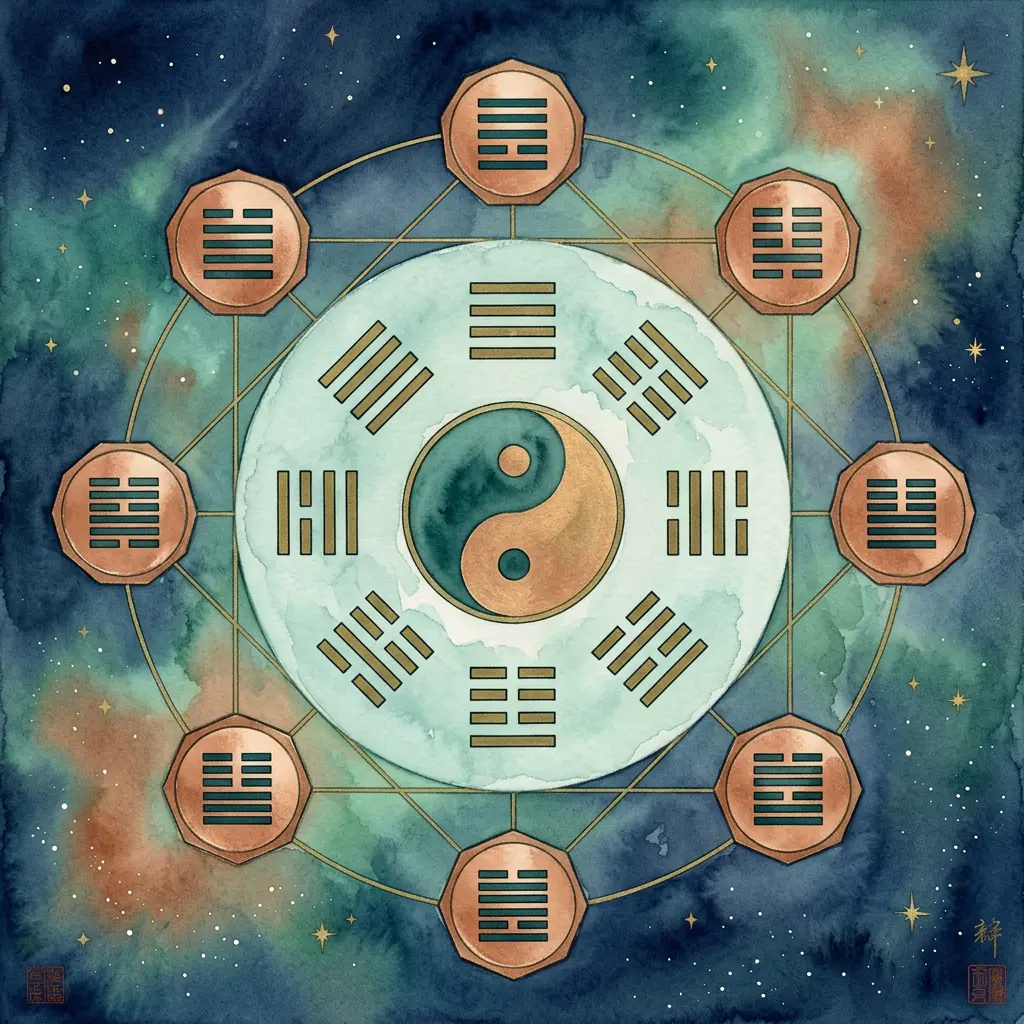
Both astrology and the I-Ching started as predictive tools. Babylonian priests predicted the king's fate. King Wen consulted the hexagrams about battles. For most of their history, these systems were used to ask what was going to happen.
That use makes sense in worlds where life and death were closer to the surface. If the wrong decision meant famine or war, you wanted a method, any method, to tip the odds.
Something different is happening now. Most of us who work with these systems no longer use them to predict events. We use them to read energy. They help us name what a season is asking of us, and what we are working with internally. The point was never better answers. It was better questions.
That is why I call them self-navigation systems. The framing is intentional. A self-navigation system gives you a map of your interior, not a forecast of your exterior. It returns you to your own authority instead of standing in for it. You are still the one walking. The map only shows you where you are.
The ancient priests and priestesses believed. We get to do something different now. We can sit with the systems, let them work on us, and see what comes through, without giving up the critical mind we have spent the last few centuries earning.
Why ancient tools still matter
These systems are not scientifically proven, and they were not built to be. Asking whether astrology or the I-Ching is "real" the way physics is real is asking the wrong question of them.
What they offer is a language for layers of experience that don't have other names. The mythopoetic, the symbolic, the felt sense, the recurring pattern, the seasonal mood. Most of modern life has no language for those layers. We have words for the empirical and words for the emotional, not much in between.
Five thousand years of people watching the sky and consulting the hexagrams suggest that the in-between layer is real, and worth speaking to. The systems are how we have spoken to the unseen. They still work, in the only way it makes sense to ask them to work. They bring us back to ourselves.
Frequently asked questions
What is an oracle?
An oracle is a way of asking a question that rational thought alone cannot fully answer. Different cultures built different oracle systems: the Pythia at Delphi, the Norse runes, the Yoruba Ifá, the Tibetan Mo. They are all doing the same thing: bringing a question to something larger than the rational mind and listening to what comes back.
How old is astrology?
The earliest organized astrology comes from ancient Mesopotamia, around 2000 BCE. The oldest surviving astrological text, the Enuma Anu Enlil, dates to roughly 1500 BCE, which makes it about three and a half thousand years old. Even earlier sky observation, more proto-astrological than systematic, may go back to Sumerian times around 3000 BCE.
How old is the I-Ching?
The earliest layer of the I-Ching was written in the Western Zhou period, around 1000 BCE. The sixty-four hexagrams were named and arranged by roughly 800 BCE. The text grew through the Warring States and Han periods, including the addition of the Confucian commentaries known as the Ten Wings. It has been continuously consulted for about three thousand years.
Why do you call them self-navigation systems instead of oracles?
The word "oracle" carries a predictive connotation that doesn't match how I use these systems. I am not predicting your future. I am reading what is moving in your chart or your hexagram and reflecting it back to you, so you can navigate your own decisions with a clearer sense of what you are working with. "Self-navigation system" describes that more honestly.
Are astrology and the I-Ching scientifically proven?
No, and they were not built to be. Both systems describe layers of experience that empirical science doesn't try to measure: the symbolic, the mythopoetic, the recurring pattern, the felt sense of a season. Whether they are useful is a different question from whether they are scientific. For me, the test is whether sitting with them produces real change. After thousands of years of practice, the answer is still yes for many of us.
Sources
The historical claims in this article draw on the following.
On Babylonian astrology
- "Babylonian astrology." Wikipedia. en.wikipedia.org/wiki/Babylonian_astrology
- Ptolemy, Claudius. Tetrabiblos. c. 150 CE. (Multiple modern editions; the Loeb Classical Library edition is the standard academic reference in English.)
On the I-Ching
- Wilhelm, Richard, trans. The I Ching or Book of Changes. English translation by Cary F. Baynes. Foreword by C. G. Jung. Bollingen Series XIX. Princeton University Press, 1950 (third edition 1967).
- Shaughnessy, Edward L. The Origin and Early Development of the Zhou Changes. Brill, 2022.
- "What Is the I Ching?" ChinaFile (NYRB China archive). chinafile.com/library/nyrb-china-archive/what-i-ching
On the "believe nothing, entertain possibilities" framing
- Casey, Caroline W. Making the Gods Work for You: The Astrological Language of the Psyche. Harmony Books, 1998.