
An Astrological natal chart is a map of the sky at the exact moment you were born. Where the Sun was, where the Moon was, where each planet sat, and how they angled to each other, all frozen at your first breath and drawn as a wheel. That wheel is your chart. It's yours and no one else's, unless someone was born at the same minute in the same place.
Your natal chart is a map of the forces you're working with. It names your strengths, your repeating challenges, the seasons of your life that ask different things of you. It's the oldest of the tools I work with by thousands of years, the language of nature written overhead the night you arrived.
And here's what it isn't, because this is where people get confused. It isn't a forecast of who you'll become. These are outdated beliefs based on dogmatic ideas. It isn't a fixed fate you're stuck with. The chart is the material you're working with, and what you do with that material is the interesting part. We look into the stars to find the mytho-poetic imprint of the soul, not a script for the life.
I call the natal chart a self-navigation tool, and I mean that precisely. It's one of three I work with, alongside Human Design and the Gene Keys, and they belong to the same family: maps for the inner terrain rather than forecasts of the outer life. A self-navigation tool is a mirror that hands you back your own authority. A map you steer by, not a driver that takes the wheel. The word "navigation" is the whole point. You're the one moving, you're the one steering, and the chart just tells you where you are.
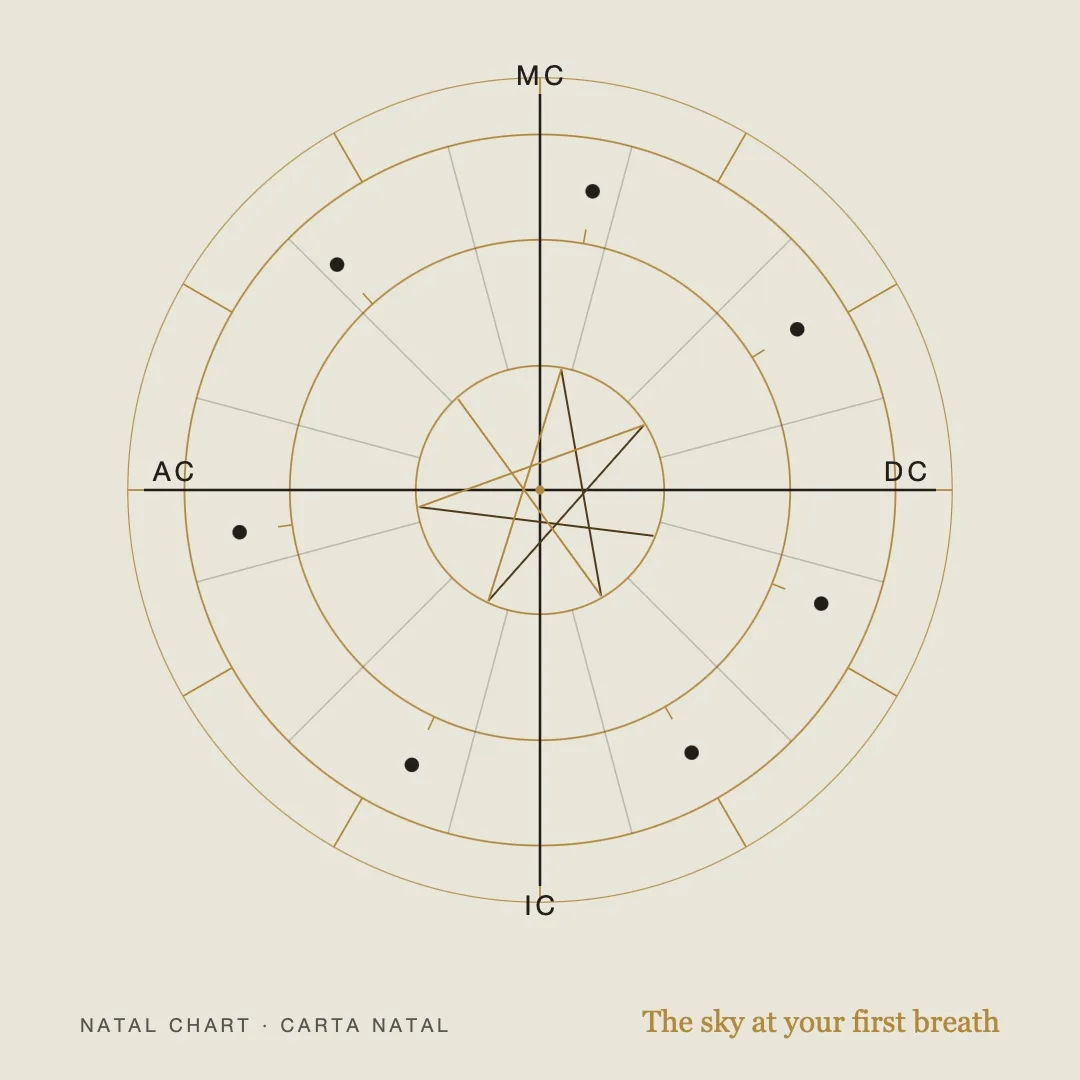
How a natal chart is built
Three things go into it, and all three matter: date, time, and the place of your birth.
The date sets the Sun and the slower planets. The place sets your horizon. And the time, this is the one people underestimate, sets the houses and the rising sign, which shift by a full degree every four minutes. Without an accurate birth time, the houses are guesswork, and I'll say so in a reading rather than pretend otherwise. So if you can find your exact time, find it. It's the difference between a sharp map and a blurry one. A reading still can be done without the exact time; the important thing is informing the practitioner about the situation.
The Moon gets read first in the way I work. The Moon is closest to home, it moves the fastest, and it holds the emotional body, what you need to feel safe, fed, held. The rest of the chart organizes around it. It's beautiful to start with the Moon because usually what everybody knows about themselves is their Sun sign.
The test that separates a mirror from an oracle
Here's the one thing I'd hold any natal chart reading to, mine included. Does it return you to your own authority, or does it take your authority away?
A good reading of your chart leaves you more in charge of your life, not less. It shows you the terrain and hands you back the wheel. A bad one, or a good one used badly, leaves you smaller. Fated. Waiting for something to happen to you, or checking the chart before you trust your own gut. If a reading makes you feel like you can't, pause. That's the misuse, not the map.
This is the line between a self-navigation tool and a fortune-teller, and it runs through everything I do. Prediction hands your agency away and asks you to brace for what's coming. Navigation hands your agency back and asks you to steer. Same chart, same planets. The difference is entirely in how you hold them.
What is a Human Design Bodygraph?
The natal chart isn't the only way to map the moment you were born. Human Design draws the same birth data as a different picture, and that picture is called the Bodygraph.
A Bodygraph is a body-shaped diagram made of nine centers, connected by channels, switched on or off by your specific birth data. Where a natal chart speaks in planets and signs, the Bodygraph speaks in mechanics: your type, your strategy, your authority, how your energy is built to make decisions and where it isn't. It's the more engineering-minded of the two. Less the poetry of the sky, more the wiring diagram of you. I go deeper into type, strategy, and authority in Gene Keys and Human Design: How Do They Relate?
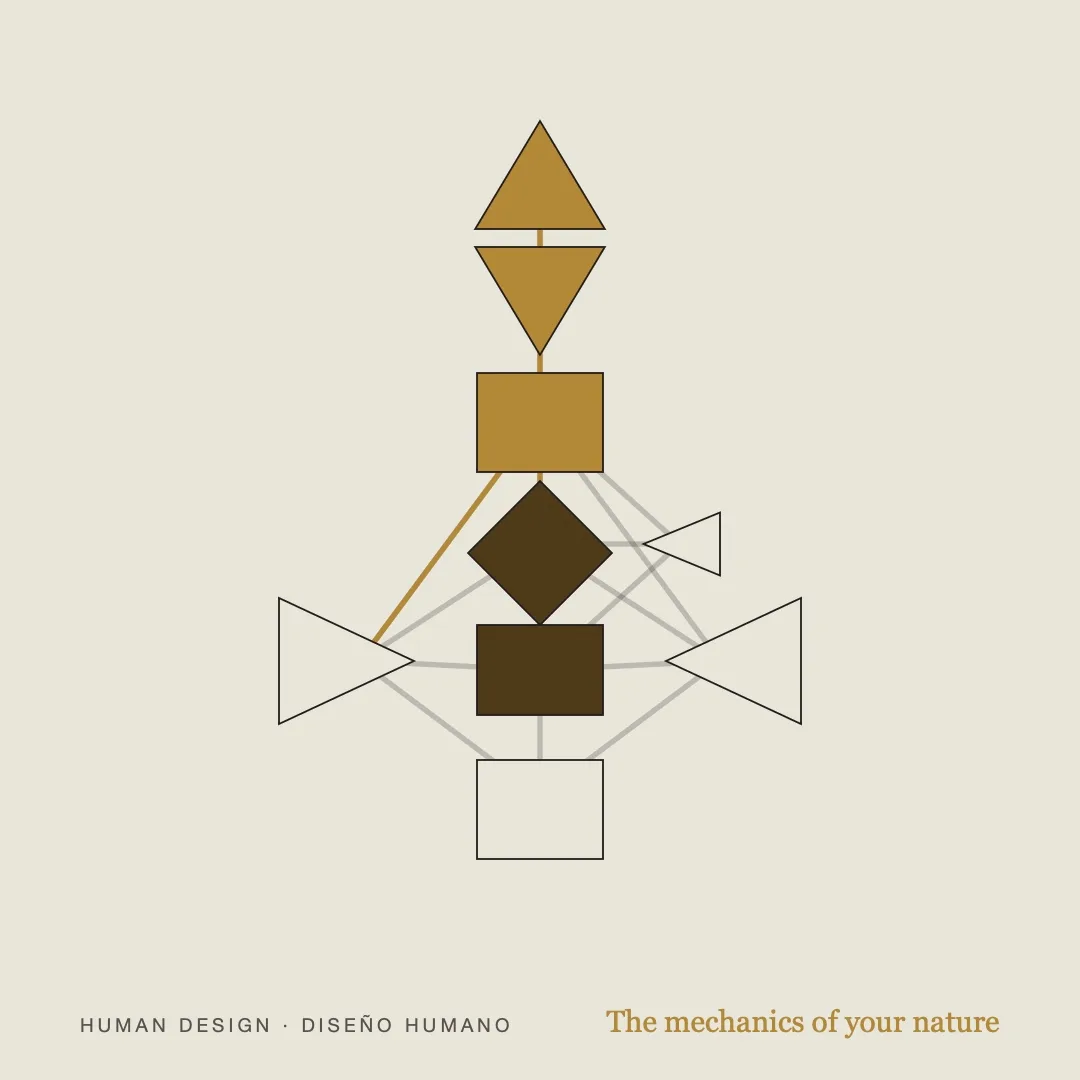
The Bodygraph and the natal chart draw from the same birth moment, so they're two readings of one map. One tells you the archetypal weather you were born into. The other tells you the mechanics of how you're built to move through it.
What is a Gene Keys Hologenetic Profile?
There's a third way to read the same moment, and it's the most contemplative of the three. The Gene Keys call it your Hologenetic Profile.
A Hologenetic Profile takes your birth data and maps it onto the 64 Gene Keys, the same 64 archetypes carried in the I Ching and in our DNA. It gives you a set of specific keys to sit with, each one holding a Shadow, a Gift, and a Siddhi, a fear-based pattern that can turn, slowly, toward its highest expression. Where the Bodygraph shows you the mechanics, the Hologenetic Profile hands you a path of inner work, one key at a time. You don't read it fast. You contemplate it.
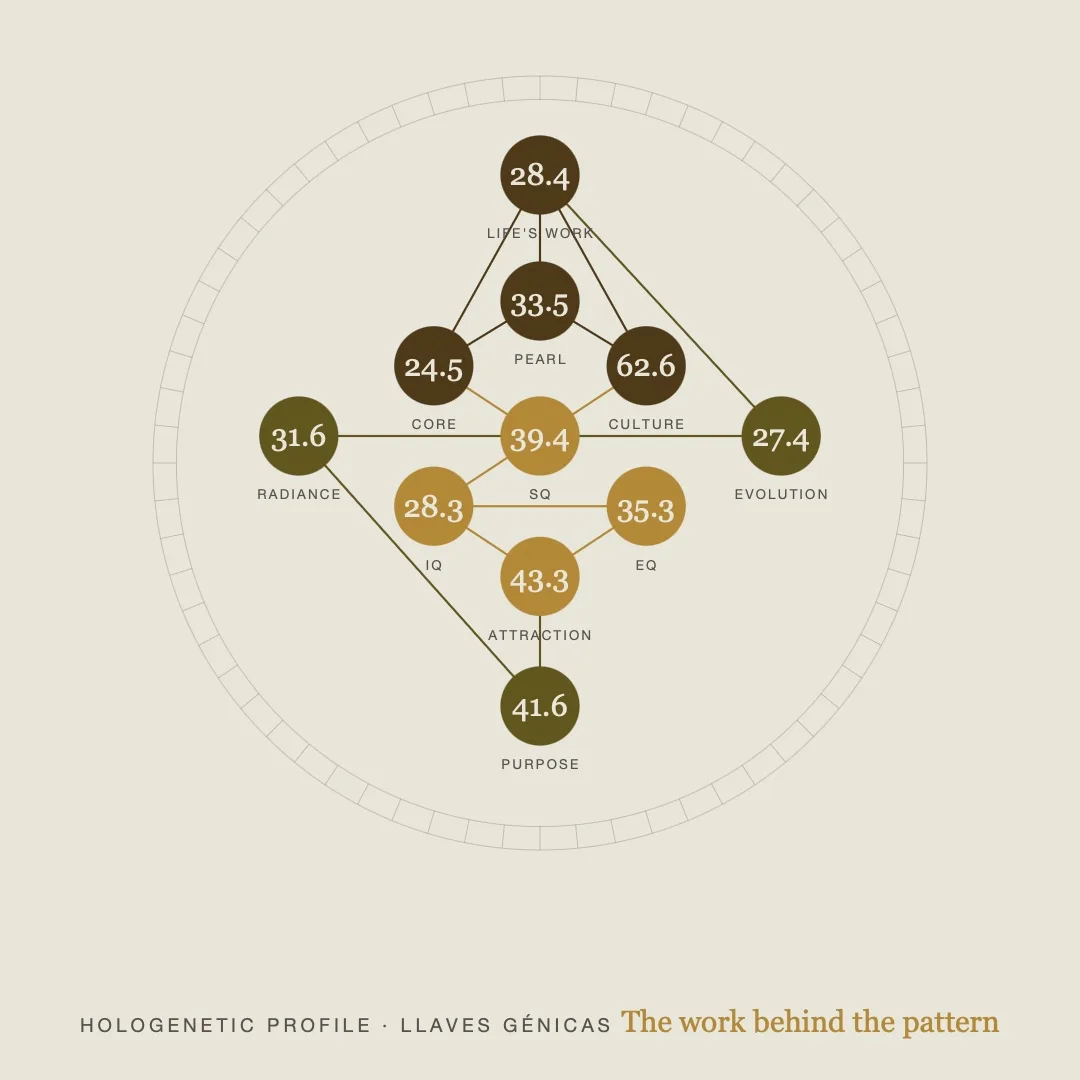
Same moment, three maps
So the natal chart, the Bodygraph, and the Hologenetic Profile are three readings of one thing: the moment you took your first breath. Same birth data underneath. Three different languages drawn from it.
This is why I work with all three. They're three self-navigation tools drawn from one moment, and they share a root, in Astrology and in the I Ching, so they rhyme. When the natal chart, the Bodygraph, and the Hologenetic Profile all point at the same theme, the signal gets strong, and that's a lot of what a reading is actually listening for. Where they seem to disagree, that's not a problem either. That's a place to look closer, a tension worth reconciling rather than smoothing over. We all hold all sorts of inner tensions.
But is any of it real?
You might be wondering whether a chart drawn from planets can really say anything true about you. I want to meet that honestly. None of these systems is scientifically proven, and they weren't built to be. Asking whether a natal chart is real the way gravity is real is asking the wrong question of it.
We aren't fully rational beings. If we were, we wouldn't do half of what we do to ourselves. There's a whole layer of us, the intuitive, the symbolic, the felt, that reason alone doesn't reach, and these maps give that layer a language. That's what they're for. It's why the natal chart still works, after thousands of years, in the only way it makes sense to ask it to. It brings us back to ourselves.
Where to start with your own chart
So here's what I'd leave you with. Pull your natal chart. There are free ones online, all you need is your date, time, and place of birth. Look at your Moon first. Not your Sun sign, the one everybody knows. Your Moon. Read what it needs, and then ask the one question that tells you whether you're holding the chart right: is this describing a fate I'm stuck with, or a map I can finally steer by?
If it reads like a map, you're navigating. If it reads like a sentence you've been handed, put it down and pick it back up as a mirror.
Sources and further reading
- Casey, Caroline W. Making the Gods Work for You. 1998. Source of the "believe nothing, entertain possibilities" and mirror-not-prediction stance.
- Gene Keys official resource (genekeys.com). For the Hologenetic Profile and the Shadow, Gift, and Siddhi frequencies.
- Jovian Archive (jovianarchive.com). The official Human Design source, for the Bodygraph, types, and authorities.
Frequently asked questions
What is an astrological natal chart?
A natal chart is a map of the sky at the exact moment you were born: where the Sun, Moon, and planets sat, and how they angled to each other, drawn as a wheel. It maps the forces you are working with, your strengths, repeating challenges, and the seasons of your life. It is not a forecast of who you will become; it is the material you are working with.
What is a Human Design Bodygraph?
A Bodygraph is the body-shaped diagram used in Human Design, made of nine centers connected by channels that are switched on or off by your birth data. It maps the mechanics of how you operate: your type, strategy, and authority, and how your energy is built to make decisions. It draws from the same birth moment as a natal chart, read as mechanics rather than as archetypes.
What is a Gene Keys Hologenetic Profile?
A Hologenetic Profile maps your birth data onto the 64 Gene Keys, the same 64 archetypes found in the I Ching. It gives you specific keys to contemplate, each holding a Shadow, a Gift, and a Siddhi. Where a Bodygraph shows mechanics, the Hologenetic Profile offers a slow path of inner work, one key at a time.
Do I need my exact birth time for a natal chart?
Yes, if you want the houses and rising sign to be accurate. The rising sign shifts about one degree every four minutes, so without an accurate birth time the house placements are approximate. The Sun sign and the slower planets are reliable from the date alone, but a precise time sharpens the whole chart.
Are natal charts, Bodygraphs, and Hologenetic Profiles the same thing?
They are three different maps drawn from the same birth moment. The natal chart speaks in planets and signs, the Bodygraph in energetic mechanics, and the Hologenetic Profile in contemplative archetypes. Because they share a root in Astrology and the I Ching, they often point at the same themes, and reading them together strengthens the signal.